
How to Distinguish the Quality of White Mirror Glass Sand: A Procurement Guide for Terrazzo, Engineered Stone, and Handicrafts

How to Distinguish the Quality of White Mirror Glass Sand: A Procurement Guide for Terrazzo, Engineered Stone, and Handicrafts

Many clients in the flooring, engineered stone, and crafts industries often ask the same question: why do products labeled as “white mirror glass grit” vary so significantly—with some appearing clear and brilliant, while others look dull, greyish, or like ordinary crushed glass—and why is there such a large price gap between them?

The core difference lies in the choice of raw materials and the comprehensive, high-precision processing steps employed. Standard transparent glass grit is often produced from a mixture of green and amber-tinted glass. In contrast, high-quality “white mirror” glass grit is crafted primarily from colorless float glass or mirror-grade glass. It undergoes a rigorous production process—including crushing, multi-stage water washing, magnetic iron removal, manual and optical (color-based) impurity sorting, multi-level screening, and dust removal—resulting in particles that are exceptionally clear, offer uniform mirror-like reflection, and are entirely free of off-colored specks or black spots.

I. Four Acceptance Criteria for High-Quality Clear Mirror Glass Sand (You May Verify These Upon Receipt)

1. Transparency and Reflectivity: Examine a handful of the crushed material on a sheet of white paper under natural light. High-quality “white mirror” (reflective glass) particles should be clear and bright, with facets that exhibit a mirror-like reflection. Inferior-quality material may appear hazy or yellowish, contain internal air bubbles or inclusions, and fail to produce a sparkling effect under light.
2. Impurity Level: The presence of black specks, colored fragments, or iron filings is a major drawback. For high-end terrazzo or engineered stone countertop projects, clients often demand an extremely low impurity level; once impurities are mixed into the epoxy resin and the material is cast, they cannot be removed, inevitably necessitating rework.
3. Particle Size Uniformity: Particles within the same batch should be consistent in size, with minimal fine powder. An excess of fine powder diminishes the sparkling aesthetic and can also lead to the formation of air bubbles during the epoxy mixing process.
4. Physical Stability: The material should be resistant to water and immersion in resin, and it should not darken or discolor during the polishing process. Some low-cost “white mirror” products are merely crushed without proper cleaning, leaving oily residues on the surface that can cause pinholes and air bubbles when they come into contact with epoxy resin.
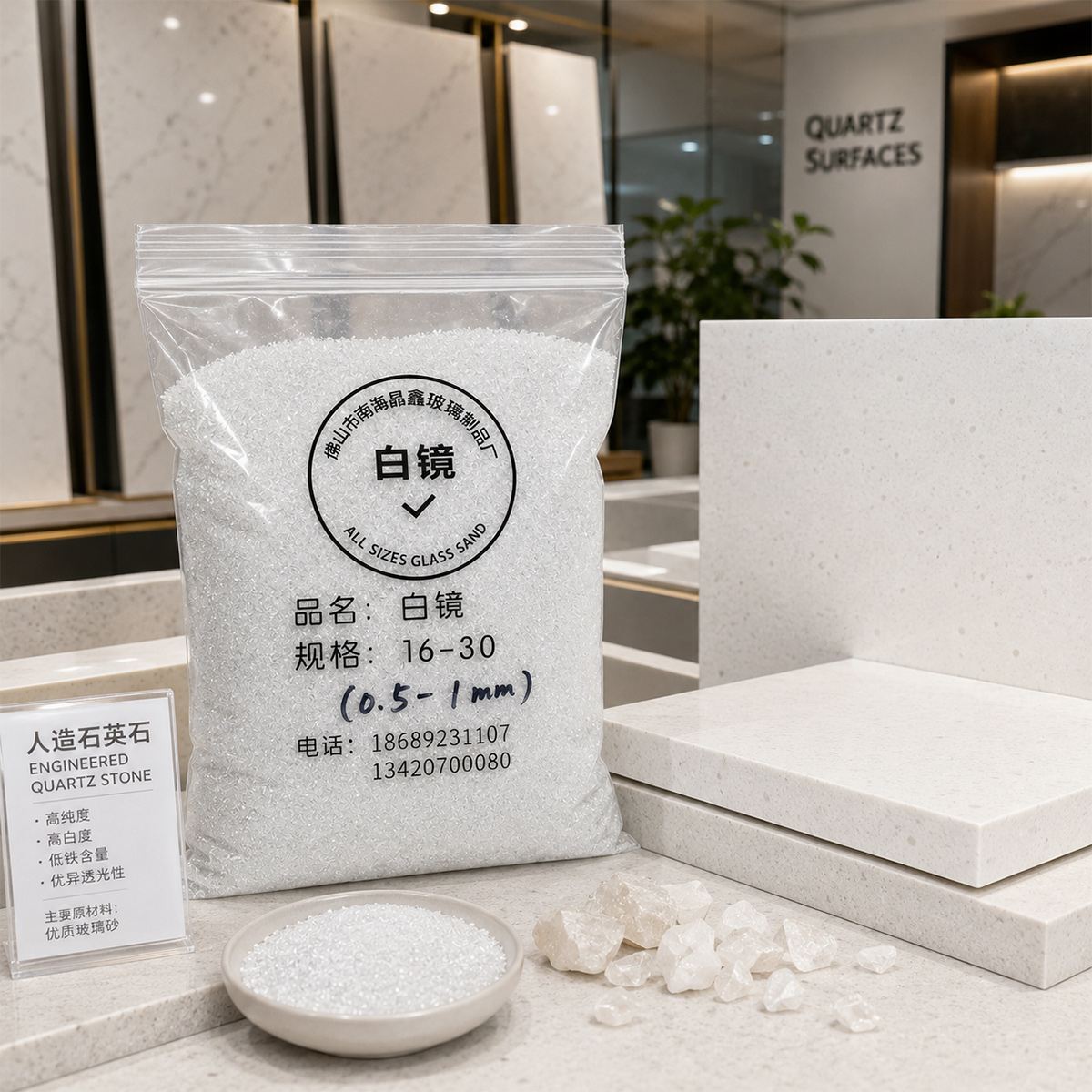
II. Common Configuration Options for Clear Mirror Glass Sand (Widely Used in Projects and Manufacturing)

1. Minimalist “Clear/Clean” Style Terrazzo: A blend of white mirror fragments and standard clear glass granules (in an 8:2 or 7:3 ratio) creates a crisp, silvery sparkle. This is ideal for showrooms, offices, and public areas in shopping malls.
2. “Affordable Luxury” Terrazzo and Engineered Stone Countertops: A combination of white mirror fragments and **gold-toned granules** produces an interplay of gold and silver glints. This option commands a higher market value and is a popular choice among designers.
3. Epoxy Crafts and “Quicksand” Ornaments: Fine-grade white mirror fragments (40–80 mesh) serve as an excellent base aggregate, providing a clean, luminous, and transparent aesthetic.
4. Permeable Landscape Concrete and Tree-Pit Landscaping: Coarse-grade white mirror fragments (8–20 mesh) offer superior outdoor weather resistance, ensuring they do not rapidly yellow or lose their luster under prolonged sun exposure.

Important Technical Note: White mirror fragments are intended exclusively for decorative use and are **not recommended for sandblasting or abrasive finishing**. Doing so is not only cost-inefficient but also causes the mirror facets to shatter rapidly under high-speed impact, effectively destroying the sparkling effect and resulting in a waste of material.
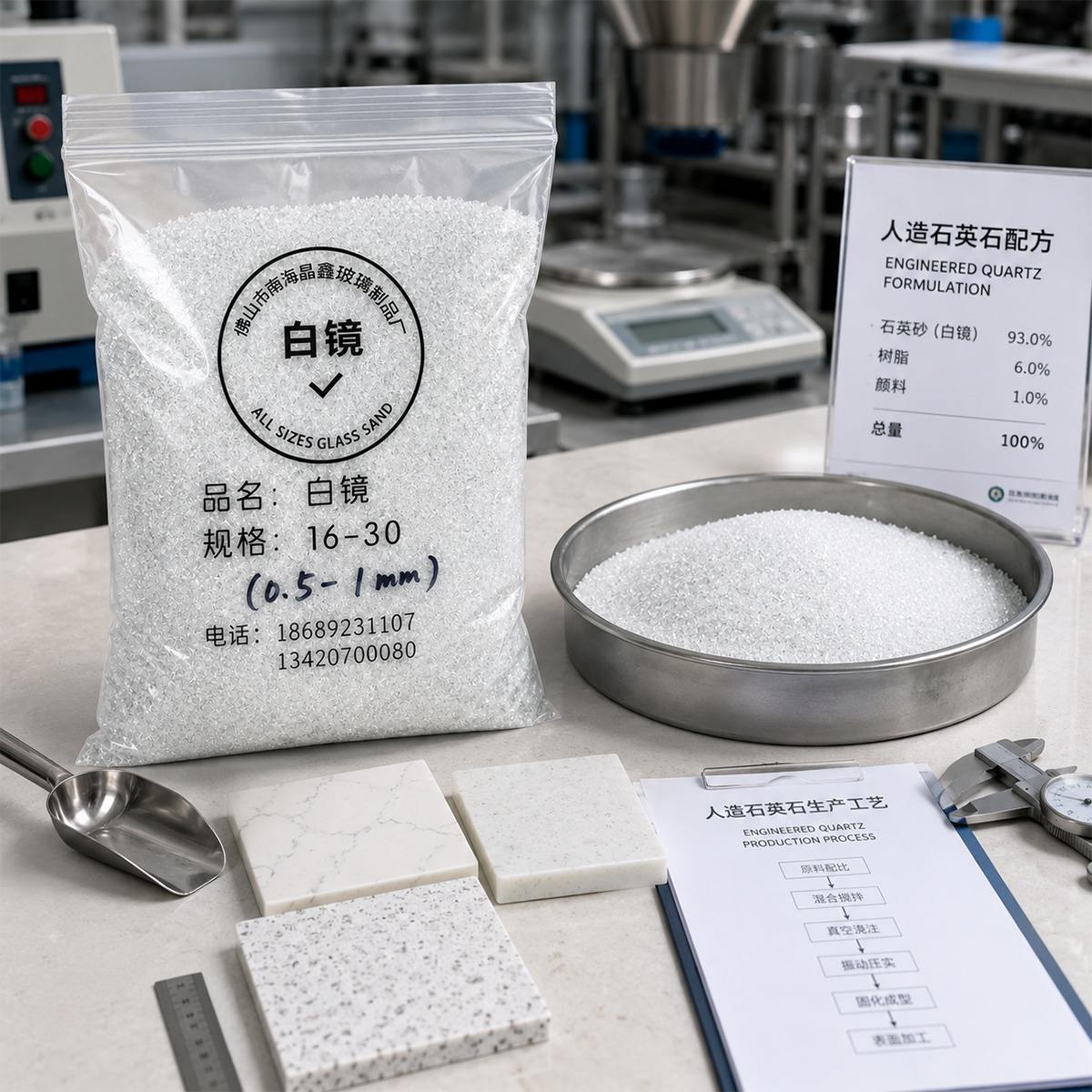
III. Most Frequent Customer Feedback & Solutions

Q1: Why do small black spots appear on the surface of the finished terrazzo after pouring?
A: This is most likely due to inadequate raw material sorting, where glass contaminants or iron filings were not removed. Solution: Switch to high-purity white mirror glass (crushed glass) and test a small sample by mixing it with resin before accepting a full shipment.
Q2: Why does the reflectivity/brightness of the white mirror glass vary between batches?
A: This often happens when suppliers source materials from inconsistent or mixed origins. Working with a primary manufacturer that maintains fixed raw material channels and standardized sorting processes ensures better batch-to-batch consistency.
Q3: Why do so many air bubbles form after mixing with epoxy?
A: This is usually caused by excessive dust or oil residue on the surface of the glass particles. High-quality white mirror glass undergoes a water-washing and dedusting process to minimize dust; additionally, drying the material before mixing can further reduce the risk of air bubbles.

Foshan Nanhai Changxin Glass Building Materials Factory operates its own production lines for processing white mirror glass (crushed glass). We source colorless, clear glass from designated suppliers and employ a color-sorting and impurity-removal process. We offer products categorized by particle size and purity level to meet the diverse requirements of residential and commercial interior projects, municipal landscaping, engineered stone (reconstituted stone) production, and handicrafts. We provide both standard-grade and high-purity (spot-free) versions. We welcome you to request samples to test for reflectivity, air bubble formation, and impurity levels within your specific epoxy system before placing a bulk order. We also offer complementary glass aggregate products—such as metallic-effect glass particles and standard glass aggregates—ensuring consistent batches and more stable color matching.