
When sourcing glass grit for the first time, many procurement professionals fall into a common trap: assuming that all glass grit is the same and that any specification will work for any application. It is often only after the material arrives and is put into use that various problems emerge—such as excessive dust and rapid consumption during sandblasting; high silt content leading to premature caking when used as a water filtration medium; or the presence of dark specks and a dull, cloudy appearance when used in terrazzo decoration. The fundamental reason for this is that **glass grit is not a monolithic product category; different applications require specific grades, screening standards, and processing techniques, meaning they cannot be used interchangeably.**
To clarify the basics: glass grit is a granular aggregate produced from recycled glass through a series of processes, including crushing, magnetic iron removal, washing (to remove silt), multi-stage screening, dedusting, and drying. Although all these products are referred to as “glass grit,” we categorize them into three distinct grades based on their intended use: sandblasting/abrasive grade, water filtration grade, and decorative/filler grade (which includes specialized decorative variants like white mirror-glass grit and gold-colored glass granules).
1. Particle Size (Mesh Count): This is the primary reference metric. A higher mesh count indicates finer particles, while a lower mesh count indicates coarser particles.
– 8–20 mesh: Coarse particles, typically used for landscape surfacing, large-aggregate terrazzo, and as filler for thick-layered resin ornaments.
– 20–40 mesh: A popular, versatile specification; commonly used as terrazzo aggregate, for general sandblasting, and as filler for crafts.
– 40–80 mesh: Fine sand, used for precision sandblasting (matte/satin finish), thin-layer epoxy crafts, and surface detailing.
– Above 80 mesh: Micro-powder grade; generally not recommended for sandblasting or filtration—primarily used as a filler in coatings and glazes.
Important Note: Many low-cost products undergo only rudimentary screening, resulting in a mixture of coarse and fine particles. A product labeled as “20–40 mesh” might actually contain significant amounts of fine dust and oversized particles, which can negatively impact the final result. Reputable manufacturers employ multi-stage vibrating screens to ensure precise grading and consistent mesh-based packaging.
2. Impurity Content: Contaminants such as iron filings, silt/sediment, oil, and dark-colored glass fragments are critical factors to control.
For sandblasting: Iron filings can adhere to the workpiece surface and cause rust spots; therefore, magnetic separation is essential to remove iron.
For water treatment: High silt or sediment content can rapidly clog filter tanks; washing is required to remove these fine impurities.
For decorative applications (e.g., white mirror glass, gold-colored glass granules): Even the smallest dark impurity will be magnified when embedded in epoxy or resin, necessitating the highest standards of cleanliness.
3. Hardness and Brittleness: Glass grit has a Mohs hardness of approximately 5.5–6, which is lower than that of quartz sand. Its advantage is that it does not excessively damage or gouge the workpiece, making it ideal for matte-finish sandblasting on aluminum alloys, stainless steel, and acrylic. A drawback is that the particles tend to fracture during repeated use; therefore, some material loss should be expected in sandblasting operations. It is best to select products with uniform, angular particles and low dust content.
4. Chemical Stability: Chemically neutral and resistant to acids and alkalis, glass grit is suitable for use in water treatment, outdoor flooring, and water features (even with long-term water immersion), as it does not leach harmful substances.
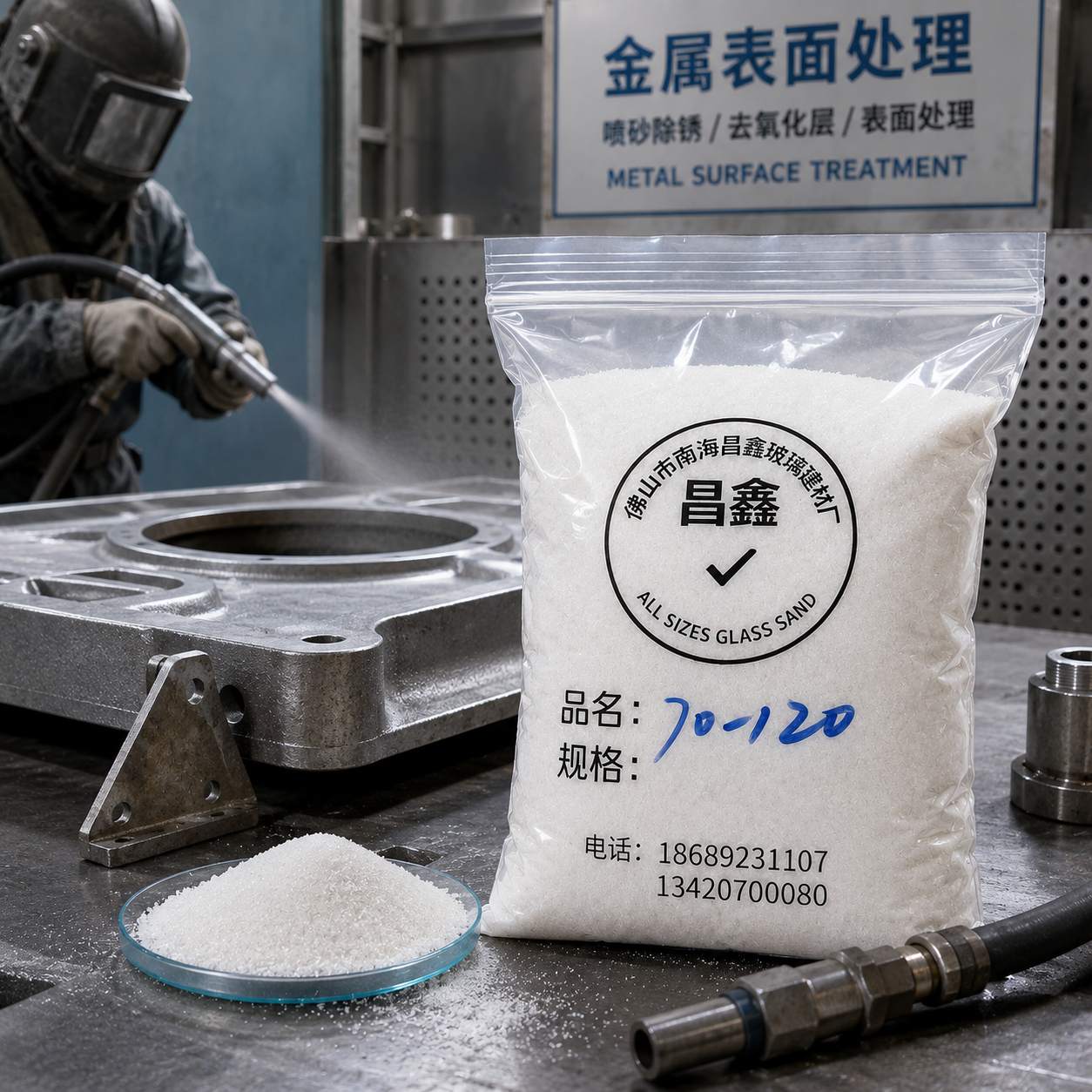
✅ Industrial Sandblasting/Abrasive Blasting: Use “sandblasting-grade glass grit”—ideally in 20–40 or 40–80 mesh sizes. It should have low iron content and minimal dust. Suitable for sheet metal, molds, glass frosting (etching), and removing paint or oxidation. Avoid using decorative “white mirror” glass or gold-colored glass particles, as they are costly and their colored coatings tend to wear off, leading to waste.
✅ Water Treatment Filter Media: Use “filter-grade glass grit”—ideally in 10–20 or 20–30 mesh sizes. Key specifications include a silt/clay content of <1%, zero oil contamination, and well-rounded particles. Used in filtration tanks for swimming pools, reclaimed water, and sewage treatment.
✅ Terrazzo and Engineered Stone (for residential or commercial projects): Use “decorative-grade glass grit.” Start with a base of clear glass grit, then incorporate “white mirror” glass for a reflective, sparkling effect, and add gold-colored glass particles for a touch of “affordable luxury.” Typically used in 16–40 mesh sizes.
✅ Epoxy Resin Crafts, Aromatherapy Products, and Quicksand Art: Use decorative-grade “white mirror” or gold-colored glass particles, primarily in fine 20–60 mesh sizes. These must be free of black specks and color-fast (resistant to fading).
Pitfall 1: Suppliers provide only the mesh size without specifying the grade. For instance, they may sell filtration-grade sand as sandblasting-grade, or sandblasting-grade as decorative-grade—often failing to meet the required cleanliness standards.
Pitfall 2: Recycled glass raw materials are not sorted, leading to the inclusion of colored glass fragments. This results in a yellowish or grayish tint in the final product, making it unsuitable for achieving a “white mirror” (pristine, clear) effect.
Pitfall 3: Skipping essential processes like water washing and magnetic separation, relying solely on basic screening. While this lowers production costs, it frequently leads to post-sale quality issues.
Established in 2016 in the Wuxing Industrial Zone, Shishan Town, Nanhai District, Foshan, our facility—Foshan Nanhai Changxin Glass Building Materials Factory—operates as a direct manufacturer. We implement strict grade-based segregation during production: sandblasting-grade, filtration-grade, and decorative-grade (including “white mirror” and gold-toned particles) are processed on separate production lines and stored in distinct areas, ensuring no cross-contamination during shipment. Simply let us know your intended application, desired mesh size, whether you require a sparkling effect, and any specific technical testing requirements. We will provide the most suitable glass sand solution for your needs, with the added convenience of one-stop sourcing for quartz and engineered stone raw materials.
Notifications